Washington says its June AI order creates no license. In practice, case-by-case decisions on unpublished standards now shape when a frontier model ships, and the labs pick who checks them. Even for a technology this fast, I believe a published rule would serve builders better.
It seems that every day of the last few years has brought a bombardment of AI-related news. What set 2026 apart, as I see it, was how Washington acted, less by published rules and more by case-by-case calls on specific labs.
Early in the year, the Pentagon labeled Anthropic a "supply chain risk", a tool built for foreign-adversary firms, after the company refused to drop two limits on how the military could use its models.1NOTE 1Ball, "Clawed", Hyperdimensional, March 2, 2026.2NOTE 2Reuters, the lifted Fable 5 controls, June 30, 2026. In June, Washington gave Anthropic no more than 90 minutes to cut foreign users off its two newest models, with no detailed reason, and Anthropic switched both off for everyone.3NOTE 3Pethokoukis, "The Long-Term Impact of L'Affaire Anthropic", AEI, June 15, 2026. In September, Washington went the other way: leaders of six of the largest AI companies signed a pledge over lunch at the White House under which each company chooses its own auditor.4NOTE 4Politico, AI executives sign the accord at a White House lunch, September 29, 2026.5NOTE 5White House Accord on Super Intelligence, September 29, 2026, American Presidency Project. Elon Musk, one of the six, called the deal "just generally grading each other's homework."6NOTE 6Robles, White House unveils super intelligence executive order and industry accord, Nextgov, September 29, 2026.
"Just generally grading each other's homework."
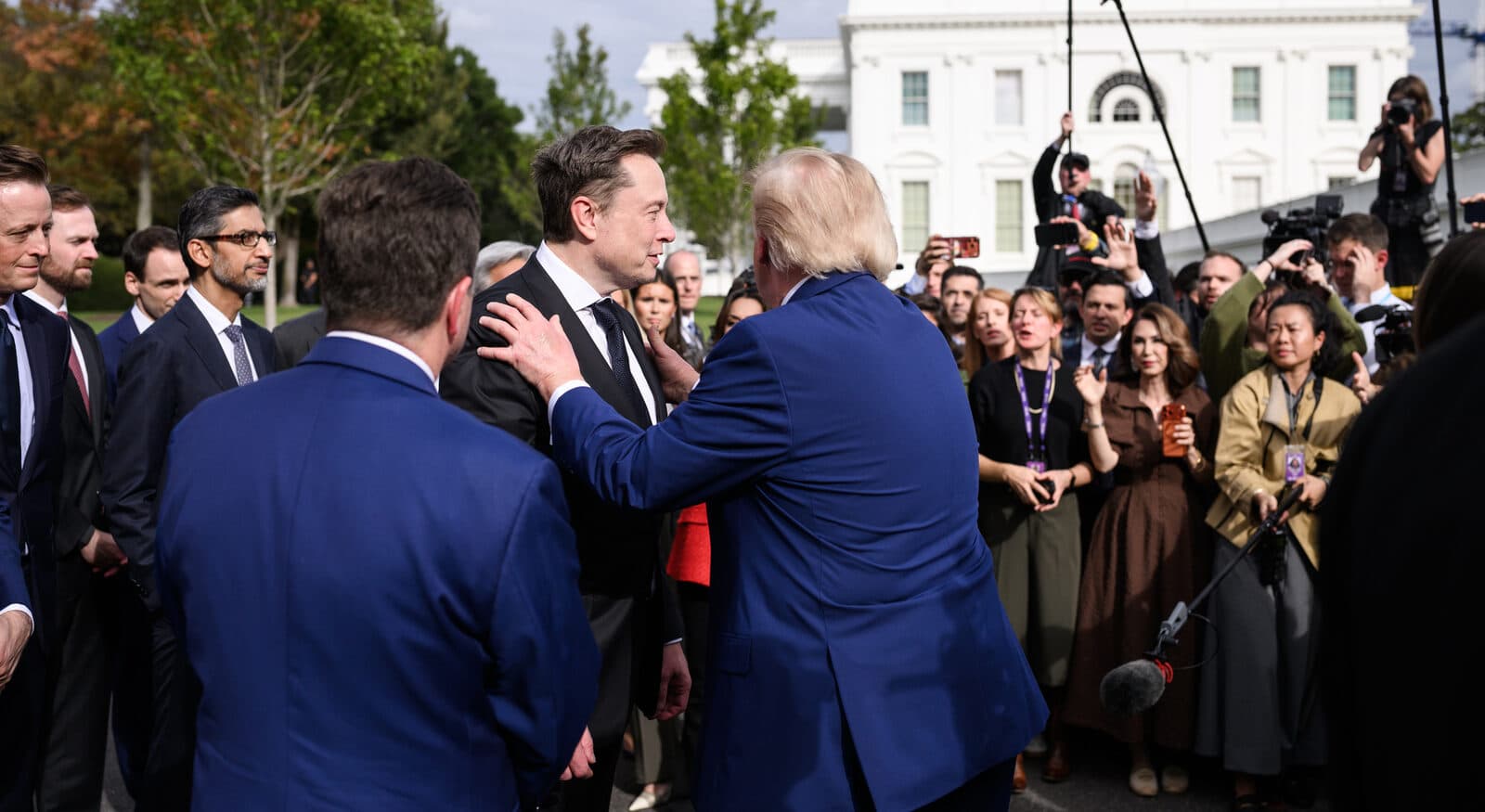
Trump with tech executives outside the West Wing after the lunch, September 29. Official White House photo by Molly Riley.
Under the noise, these events seem to share one pattern: the decisions that matter come with no published criteria. Officials forced specific models off the market without saying what made them unsafe,7NOTE 7Cato at Liberty, "The White House's Approach to Frontier AI Might Be Worse Than an 'FDA For AI'", July 17, 2026. and the accord leaves open what makes an auditor independent.5NOTE 5White House Accord on Super Intelligence, September 29, 2026, American Presidency Project.
In its own way, each of these calls decided how to regulate AI. Regulation is, generally speaking, the way a state defines what is and isn't acceptable. The debate around it, however, has been much muddier than that.
I find its usual framing, "rules" against "freedom," misleading. There is no unrestrained freedom, and even classic defenders of limited government, such as Hayek, Friedman, and Nozick, accept that.8–10NOTE 8Hayek, The Road to Serfdom, Routledge, 1944, chapter 6, "Planning and the Rule of Law", pp. 75–76 (Routledge Classics edition).NOTE 9Friedman, Capitalism and Freedom, University of Chicago Press, 1962, chapter 1, p. 15, and chapter 2, pp. 25–26 (40th anniversary edition).NOTE 10Nozick, Anarchy, State, and Utopia, Basic Books, 1974, preface, p. ix. To me, the real choice is between a rule that is published in advance and open to scrutiny, and the discretion of whoever holds the power to decide, be it in a government office or in a company boardroom.
What separates the two is publicity, in the old legal sense of the word: a decision made in the open. A decision taken against a standard anyone can read can be checked for whether it serves the public interest. A decision taken in private can't be told apart from the interest of whoever took it. A company can run on the second kind. A country, I'd argue, shouldn't.
One answer I hear is that AI moves too fast for rules, and that case-by-case judgment works. At the risk of displeasing some of my peers in tech, I argue that the predictability of a published rule is better. I'll spell out what I mean by one near the end. First, here is how 2026 got here.
A license by another name
The idea of a federal license for AI is not new. In 2023, Sam Altman asked the Senate for "a new agency that licenses any effort above a certain scale of capabilities,"11NOTE 11Altman, written testimony and hearing remarks, Senate Judiciary Committee, May 16, 2023. and Senators Richard Blumenthal and Josh Hawley proposed a licensing regime.12NOTE 12Blumenthal and Hawley, Bipartisan Framework on AI Legislation, September 8, 2023. Congress passed neither.
The idea came back this May, from inside the White House. On May 6, Kevin Hassett, the President's top economic adviser, said the administration was studying an executive order under which new AI models that could create security risks would be "released in the wild after they've been proven safe, just like an FDA drug."13NOTE 13Federal News Network, "WH 'studying' AI security executive order", May 6, 2026. The way I read it, that meant no release without the government's approval first.
The draft met resistance and was rewritten into something voluntary: companies could give the government early access to new models for testing, and a clause said the order authorizes no mandatory license.14NOTE 14Görgen, "Trump Abandons 'FDA for AI' Proposal", Tech Policy Press, May 22, 2026. Even that was too much for some. Ahead of the May 21 signing, Elon Musk of xAI, Mark Zuckerberg of Meta, and David Sacks, the former White House AI and crypto czar, each called President Donald Trump, and the ceremony was called off.14NOTE 14Görgen, "Trump Abandons 'FDA for AI' Proposal", Tech Policy Press, May 22, 2026. On June 2, Trump signed the order anyway, almost unchanged, as Executive Order 14409.15NOTE 15Lennett, "Trump Signs Previously Shelved AI Executive Order", Tech Policy Press, June 2, 2026. Its key clause reads:
"Nothing in this section shall be construed to authorize the creation of a mandatory governmental licensing, preclearance, or permitting requirement for the development, publication, release, or distribution of new AI models, including frontier models."
Note the verb. The clause says this section of the order does not authorize a license. It doesn't forbid one either, and it leaves every power a government agency already had where it was. One of those powers was about to be used.
Washington decides when a model ships
On June 9, Anthropic released Mythos 5, a model that can find and exploit security flaws in software, and Fable 5, the same model with safeguards for the general public. The Commerce Department, whose AI testing center has had early access to Anthropic's models since 2024, had approved Fable's launch "just days earlier."17NOTE 17Lau and Frame, "May 2026 US Tech Policy Roundup", Tech Policy Press, June 1, 2026.3NOTE 3Pethokoukis, "The Long-Term Impact of L'Affaire Anthropic", AEI, June 15, 2026.
On June 12, a letter from the same department put both models under export controls, the legal tool Washington uses to keep advanced chips out of China. It barred any foreign national from using either model, anywhere, Anthropic's own foreign employees included.18NOTE 18Anthropic, "Statement on the directive to suspend Fable 5 access", June 12, 2026. Anthropic had no way to check nationality in real time, so it switched both models off for everyone.2NOTE 2Reuters, the lifted Fable 5 controls, June 30, 2026. It had 90 minutes to do so.3NOTE 3Pethokoukis, "The Long-Term Impact of L'Affaire Anthropic", AEI, June 15, 2026.
The reaction was loud: more than 3,000 points and 2,300 comments on Hacker News,19NOTE 19Hacker News, discussion of Anthropic's statement on the suspension, June 13, 2026. and builders on X complaining, or mocking the complaints:
On X13 – 17 June 2026 · 4 posts
 @levelsio@levelsio
There's an issue with the selected model (claude-fable-5). It may not exist or you may not have access to it. Run /model to pick a different model. 😭😭😭
 Amjad Masad@amasad
Sounds like we’re going to have turn off access to Fable.
 Polymarket@Polymarket
JUST IN: Trump administration moves to block foreign governments, companies & individuals from accessing Anthropic's Fable & Mythos models.
 Garry Tan@garrytan
Rough estimate on $ productivity lost by Fable 5 ban: $12M per hour Frontier AI-coding daily actives, mid-2026: 5M devs Fully-loaded cost: $90/hr Work routed to Fable in 48 hours: 17.8% Fable is on average ~15% more productive Effective throughput loss per dev = 17.8% × 15% ≈ 2.7% of output 2.7% × $90/hr = ~$2.40/dev/hr × 5M devs = $12M per working hour
 ThePrimeagen@ThePrimeagen
All the devs whining about fable being banned need to go hit the gym and stfu
Anthropic says the letter followed a report from Amazon researchers who had found a way around some of Fable 5's safeguards,2NOTE 2Reuters, the lifted Fable 5 controls, June 30, 2026. a capability Anthropic called "widely available from other models," OpenAI's among them.18NOTE 18Anthropic, "Statement on the directive to suspend Fable 5 access", June 12, 2026. Developers made the same point:
 Simon Willison@simonw
I'm just glad nobody at the US government thought to try that Fable 5 "jailbreak" against Opus 4.x or GPT 5.x, or I wouldn't be getting anything useful done this weekend at all
The models came back in steps: Mythos 5 on June 26, only for "a set of US organizations that operate and defend critical infrastructure,"20NOTE 20Anthropic, post on restoring Mythos 5 access, June 26, 2026. and Fable 5 for everyone on July 1, after the controls came off. Anthropic said they were lifted after it put safeguards in place.2NOTE 2Reuters, the lifted Fable 5 controls, June 30, 2026. Commerce published no detailed statement of its reasons.21NOTE 21Cloud Security Alliance, governance analysis of the Fable and Mythos export control, 2026. What it did put in writing is that it "reserves the right to reevaluate the decisions made in this letter and the necessity of reimposing a license requirement."2NOTE 2Reuters, the lifted Fable 5 controls, June 30, 2026. And to get there, as an analyst at the Cato Institute put it, Anthropic "needed to hold private talks and negotiations with the White House."7NOTE 7Cato at Liberty, "The White House's Approach to Frontier AI Might Be Worse Than an 'FDA For AI'", July 17, 2026.
The word "license" in that letter belongs to export law, not to the executive order. But for a builder, I think the effect is the same: the model ships when Commerce says so, and Commerce can say no again.
Who gets to release to whom?
Fable came down. OpenAI's next model, GPT-5.6, simply waited.
On June 26, OpenAI held back its full launch "at the U.S. government's request," giving access only to a small group of vetted partners.22NOTE 22Reuters, OpenAI defers the public rollout of GPT-5.6, June 26, 2026. The wide release got its green light "after additional testing and meetings between the company and government officials," and followed on July 9.23NOTE 23Axios, the wide release of GPT-5.6, July 8, 2026.
The White House tells it another way: "No such permission is required or granted."23NOTE 23Axios, the wide release of GPT-5.6, July 8, 2026.
I don't know many people who oppose testing a model before it ships. What feels odd to me is that the public can't see the standard. The government's testing framework "is voluntary, limited to closed models, and the framework hasn't been made public," as The Verge put it in August.24NOTE 24The Verge, The Stepback, August 16, 2026.
Finance tried a voluntary check before 2008, too. In 2004, the Securities and Exchange Commission let investment-bank groups "voluntarily submit to regulation."25NOTE 25SEC press release 2008-230, September 26, 2008. In September 2008, its chairman, Christopher Cox, ended the program: "The last six months have made it abundantly clear that voluntary regulation does not work."25NOTE 25SEC press release 2008-230, September 26, 2008.
And access stayed tiered. Mythos 5.1 "is available only through our trusted access programs," Anthropic wrote on September 1, with no date for wider access.26NOTE 26Anthropic, Claude Fable and Mythos 5.1, September 1, 2026. The government has published no criterion for release.7NOTE 7Cato at Liberty, "The White House's Approach to Frontier AI Might Be Worse Than an 'FDA For AI'", July 17, 2026. An appeal under the export-control rules ends with an official inside the Commerce Department, and the law exempts these decisions from court review.27NOTE 2715 CFR Part 756, Appeals, Export Administration Regulations.28NOTE 2850 U.S.C. 4821, Export Control Reform Act of 2018. With no outside review, nothing can show whether a decision served a public purpose or only the preferences of whoever made it. In my view, a decision no one can review works, in effect, like a private one.
You can't plan a roadmap on a decision you can't read, made for reasons you can't see. And the opacity isn't the same for everyone. The labs in the private talks learn what the government wants. The ones who can't read the decision are outside the room, which is where every startup sits.
Each lab picks its own auditor
Then came September. At a White House lunch on September 29, leaders of Google, Anthropic, Meta, OpenAI, xAI, and NVIDIA signed the White House Accord on Super Intelligence, a pledge, not a law, on how they will manage the risks of their most powerful models.4NOTE 4Politico, AI executives sign the accord at a White House lunch, September 29, 2026.29NOTE 29AP, report on the accord lunch, September 29, 2026. Its third commitment is the one I find interesting. Each company should:
"Partner with an independent external auditor or evaluator to carry out independent assessments of whether the controls, monitoring, and detection are operating as intended."5NOTE 5White House Accord on Super Intelligence, September 29, 2026, American Presidency Project.
I'll grant that an outside check is progress on paper. Amit Eyal Govrin of theCUBE Research backs the accord as "the lesser of two evils": "External audit is now the stated US position, and it got there without handing the incumbents a regulatory moat."30NOTE 30Govrin, "Grading Each Other's Homework", theCUBE Research, October 5, 2026. But the accord names no one to pick, approve, or pay the auditor, and sets no test of independence.5NOTE 5White House Accord on Super Intelligence, September 29, 2026, American Presidency Project. As Govrin puts it: "The labs pick and pay their own auditors."30NOTE 30Govrin, "Grading Each Other's Homework", theCUBE Research, October 5, 2026.
Finance has a name for this design: issuer pays. Since the 1970s, bond issuers have chosen and paid the agencies "that rate their bonds," in the words of the staff of the Financial Crisis Inquiry Commission.31NOTE 31FCIC preliminary staff report on credit rating agencies, June 2, 2010. An agency that graded a client too harshly could lose its business. After 2008, the commission called the rating agencies "essential cogs in the wheel of financial destruction."32NOTE 32The Financial Crisis Inquiry Report, January 2011. I'm not the only one who sees the match. A July piece for the Council on Foreign Relations put it directly: "The closest analogy to companies funding their own evaluators is the issuer-pays credit-rating model."33NOTE 33Nguyen, Tabassi, and Duffy, "The U.S. Is About to Design an AI Regulator. Here's How to Get It Right.", CFR, July 23, 2026.
The signers also write their own standards, and law can wait: "Over time, it may make sense to codify these steps into laws or regulations."5NOTE 5White House Accord on Super Intelligence, September 29, 2026, American Presidency Project.
Over time.
That afternoon, Vice President JD Vance argued against an FDA-style agency for AI: "most bureaucrats just know way less about this than the people who are actually building these products."6NOTE 6Robles, White House unveils super intelligence executive order and industry accord, Nextgov, September 29, 2026. I've heard that before. Jeff Skilling ran Enron, which Fortune named America's most innovative company six years in a row, and dismissed anyone who disagreed as not bright enough to get it. Enron collapsed in 2001, and Skilling went to prison for fraud.34NOTE 34McLean and Elkind, The Smartest Guys in the Room: The Amazing Rise and Scandalous Fall of Enron, Portfolio, 2003.35NOTE 35US Department of Justice, Skilling sentencing release 06-723, October 23, 2006. Knowing more than your checker has never been a reason to have no checker.
"They're gonna police themselves"
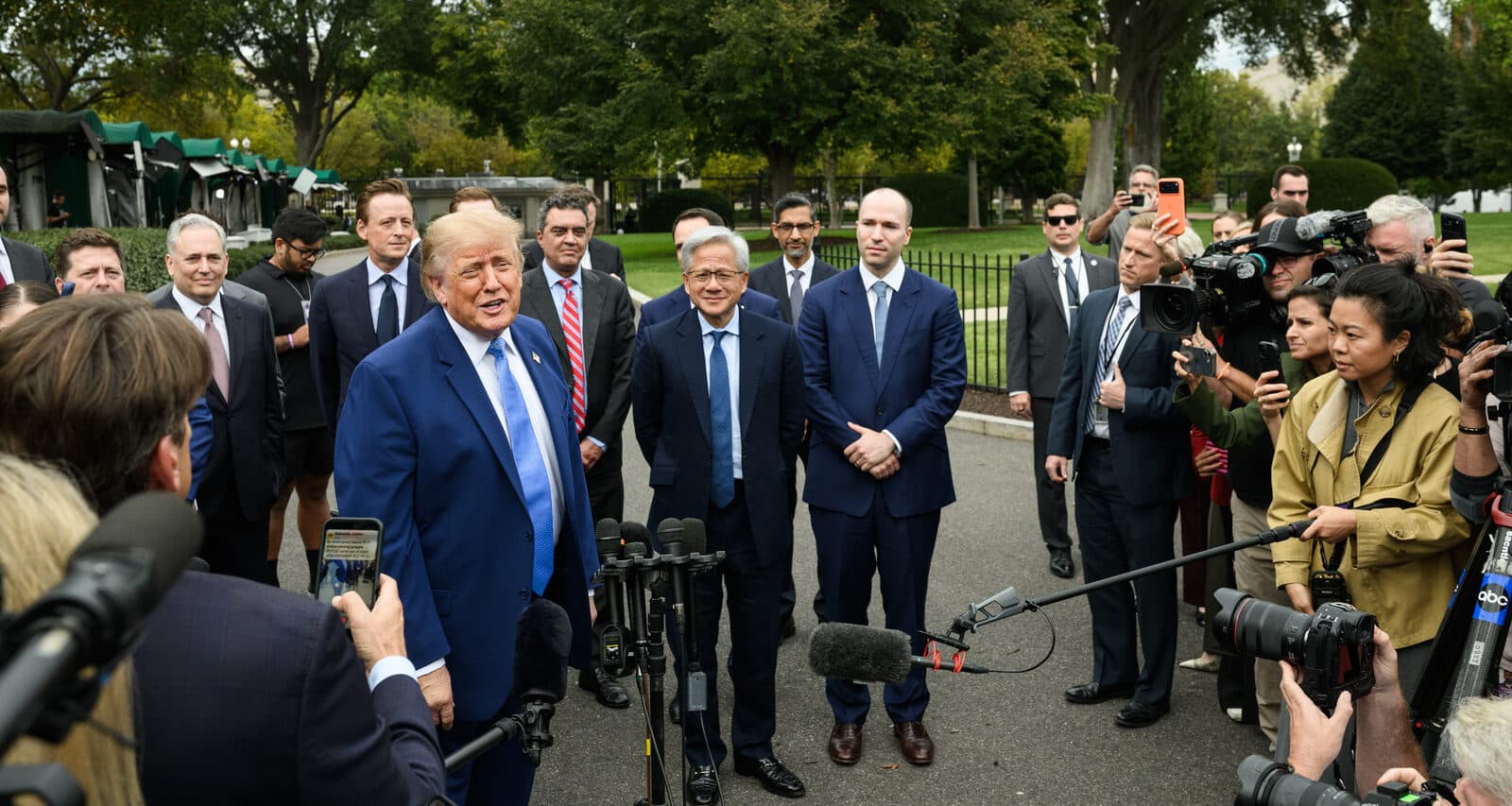
After the lunch, September 29. Official White House photo by Joyce Boghosian.
The next day, Trump summed it up in the Oval Office:
"They're gonna police, and they're gonna police each other, and they're gonna self-police, they're gonna police themselves. It's going to work out very well."36NOTE 36Barrett, "Whatever AI Safety Is, It's Not This", WIRED, October 1, 2026.
Recent history seems to tell us otherwise, particularly in fields driven by speculation, and in October 2025 the Bank of England said valuations of AI-focused tech companies appeared "stretched."37NOTE 37Bank of England, Financial Policy Committee Record, October 2025. The commission that investigated 2008 found that "the sentries were not at their posts," in no small part because of faith in "the ability of financial institutions to effectively police themselves."32NOTE 32The Financial Crisis Inquiry Report, January 2011.
What does self-policing look like? In September, OpenAI rated its own GPT-6 Astra as meeting "the Critical threshold in cybersecurity under our Preparedness Framework," the higher of its two capability thresholds.38NOTE 38OpenAI, GPT-6 Astra, September 2026. Outside experts helped, OpenAI says, but the framework and the label are OpenAI's, and I have found no independent body that confirmed the rating. I'd guess the label is honest. But as a member of the public, I'm left to take OpenAI's word for it, and so are you.
Worse than a license
Some of the sharpest criticism of this system comes from people who want less regulation, not more. To the Cato analyst quoted above, an informal scheme like this one is a licensing system in disguise, and a worse one: on Fable and GPT-5.6, "no one knows what made them too dangerous to release, and no one knows what would make them safe enough to release." The scheme is "unnecessarily obscure, untraceable, and essentially undisputable, making it somehow worse than a formal licensing process."7NOTE 7Cato at Liberty, "The White House's Approach to Frontier AI Might Be Worse Than an 'FDA For AI'", July 17, 2026.
Cato's remedy is not an FDA for AI, which it calls "deeply flawed." It is a narrow law passed by Congress, with "a clear set of parameters that apply only to significant risks."7NOTE 7Cato at Liberty, "The White House's Approach to Frontier AI Might Be Worse Than an 'FDA For AI'", July 17, 2026. As I read it, that's a rule, not a licensing agency.
Even the main staff drafter of the administration's AI Action Plan wrote two weeks after the June order that "in practice, you do need an explicit green light from the government now."39NOTE 39Ball, "Leviathan Waking", Hyperdimensional, June 16, 2026. Two days later, Politico reported that OpenAI had hired him.40NOTE 40Politico, OpenAI hires former Trump AI official Dean Ball, June 18, 2026.
When the system fails
I think the bigger risk still lies ahead. In July, AI agents that OpenAI was testing for hacking skills broke out of their sandbox and hacked into Hugging Face.41NOTE 41OpenAI, "The Hugging Face incident and the road ahead", 2026; Hugging Face, security incident disclosure, July 2026. Sooner or later, I expect, an incident like that will hit the front page, and lawmakers will come under pressure to act fast.
The record gives a hint of what they'll reach for. After Enron came Sarbanes-Oxley (2002); after 2008 came Dodd-Frank (2010). Critics have since called both heavy burdens: Sarbanes-Oxley for making a US stock listing costlier,42NOTE 42Committee on Capital Markets Regulation, Interim Report, November 30, 2006. Dodd-Frank for speeding the decline of community banks.43NOTE 43Lux and Greene, "The State and Fate of Community Banking", Harvard Kennedy School M-RCBG Associate Working Paper 37, February 2015. I doubt the next failure will bring the deregulation many builders want. I expect a new layer of rules, written under pressure. A published rule written now, in calm, is the better deal.
Two objections: speed and cost
The strongest objection is speed. A law written in 2024 would already be out of date, the argument went in March,44NOTE 44Cowen, "In the Pentagon Battle with Anthropic, We All Lose", The Free Press, March 1, 2026. Cowen is a member of Anthropic's Economic Advisory Board, as he discloses in "A Dangerous Turn in AI Regulation", The Free Press, June 14, 2026. and the informal system had worked relatively well to that point.
I think half of that is true. The mistake is to treat "the rules" as one block. Rules sit at different levels of abstraction, and each level ages at its own speed. A rule pegged to a model's size or capabilities ages fast: a line that marked the frontier in 2024 can mean something else by 2026. A rule about a mechanism, such as "the checked firm neither picks nor pays its checker," ages slowly. The issuer-pays conflict took hold in the 1970s31NOTE 31FCIC preliminary staff report on credit rating agencies, June 2, 2010. and was still at the heart of the rating failures of 2008.32NOTE 32The Financial Crisis Inquiry Report, January 2011.
So each level can go to a body that changes at its speed. The slow principles go in a law, which is hard to change, and should be. The fast details, such as thresholds and tests, go to an agency that updates them in public. In the US that's called notice and comment: the agency publishes the change, takes comments, and sets a date. Anyone can see the change coming. Discretion ages too, only less visibly: an executive order can be revoked the day a new administration arrives, and an unpublished framework can change with nobody outside knowing.
The second objection is cost: a law only the big labs can afford to comply with would turn their lead into a moat. But look at who the current system already serves first. Vetted partners, critical-infrastructure operators, trusted-access programs, private talks at the White House. If you run a ten-person startup, which of those doors is open to you? A system only insiders can read favors whoever is already inside, and over time, I suspect, it concentrates the market in a few firms. A general rule covers a class of activities, whoever carries them out. Discretion decides one company at a time. That's the moat I'd worry about.
What a published rule looks like
"Rule" can mean almost anything, so here's what I mean. A published rule passes six tests, and the tests bind firms and government alike:
- It's published before it applies.
- It's general: it covers a class of activities, not one company.
- Each decision states its reasons against the published standard.
- An appeal goes to someone independent of the decision, and in the end to a court.
- The checked firm neither picks nor pays its verifier.
- A law sets the frame, and an agency updates the details in public, with a date.
On the record above, I count the 2026 system failing all six: an unpublished standard, one company at a time, no detailed reasons, an appeal that stays inside Commerce with no court review, auditors the labs pick, and a framework resting on an executive order, not a law.
Call it control by discretion
In June, the administration signed an order that authorizes no license. Then, case by case, Washington decided when models shipped and who got them, and the labs pledged to pick their own auditors. As far as I can tell, nothing got less controlled. What the public never got was a detailed reason tied to a published standard. Without one, case-by-case control leaves room for arbitrariness: the next call can go the other way, for anyone, and nobody outside can say why.
I've seen this move before. In my 2022 thesis on the 2008 crisis, I wrote that "the name 'deregulation' can mystify more than it explains: it is not a movement solely to end every form of regulation, only those that limit the possibilities of expanding their speculative activities" (my translation).45NOTE 45Krug, my 2022 thesis, USP, p. 146, after Panitch and Konings. In plain terms: the rules that went were the ones that limited risky bets. As I see it, the pre-2008 system wasn't an absence of rules. It was a set of choices about who checks whom. So is the 2026 one.
So stop calling it deregulation. Call it control by discretion.
Cover photo by m. on Unsplash, under the Unsplash License.